
How to Search for Aircraft Spare Parts by Part Number
Dash numbers, spaces, suffixes and supersessions: why the same part is written five different ways, and how to search so you still find it.
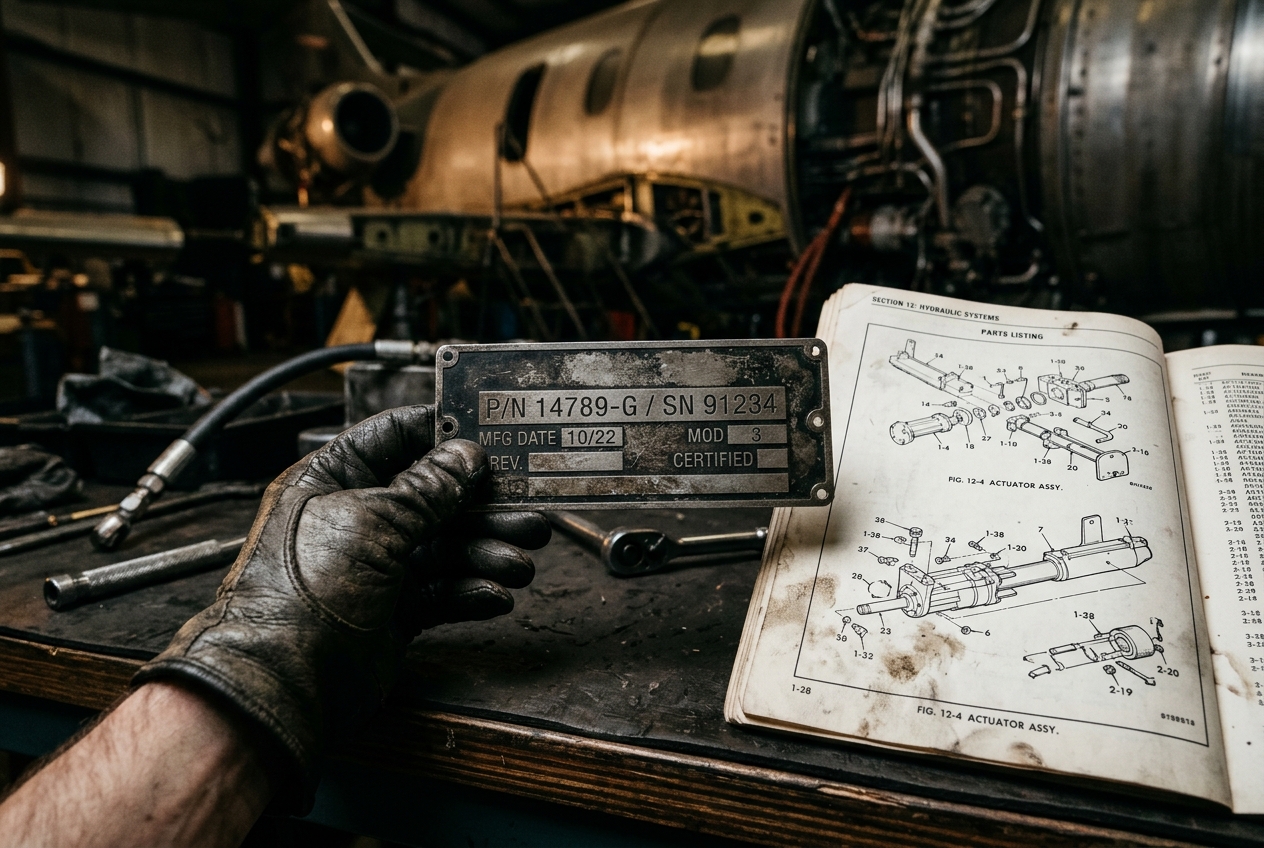
Almost every failed parts search is a formatting problem, not an availability problem. The part exists; the number was typed the way one system writes it and searched in a system that writes it another way. Knowing how aviation part numbers are constructed makes the difference.
Anatomy of a part number
Most standard numbers have three pieces: a standard or family prefix, a base number, and a dash or suffix that fixes size, material and finish. In NAS1149F0632P, "NAS1149" is the standard, "F" the material/finish family, "0632" the size, and "P" a further variant. Change one character and you have a different, non-interchangeable item — which is exactly why a search should be run on the full string first.
The same number, written five ways
The same item appears in the wild as:
- NAS1149F0632P
- NAS1149-F0632-P
- NAS 1149 F0632 P
- nas1149f0632p
- 1149F0632P (prefix dropped by a stores system)
Our catalogue search normalises punctuation and spacing, so any of those forms will find the part. It also searches alternate and superseded numbers, the manufacturer name and the description, and it puts an exact part-number match at the top of the results.
OEM numbers versus supplier numbers
The number on the unit is often the OEM number, while the number in your maintenance system may be the airframer's number for the same item. Both are valid; they simply belong to different catalogues. When you enquire, send whichever number you have and say where it came from — the nameplate, the IPC, or a previous invoice. A supplier can cross-reference in either direction, but only if they know which direction they are starting from.
Supersessions and interchangeability
Part numbers are retired and replaced. A superseded number usually still resolves, but what you will be offered is the current replacement. Treat any supersession as a technical decision, not a commercial one: check the manufacturer's service information or your approved data before accepting an alternative, particularly where the change affects fit, form or function.
Practical search tips
- Search the full number first, then progressively drop the suffix to see the family
- Search the base number to find all sizes at once — useful when a size is unavailable
- Search the description ("wheel bearing", "fuel pump") when you have no number at all
- Note the alternate numbers listed on the part page before raising the RFQ
When the number returns nothing
An empty result is not a dead end. Obsolete, hard-to-find and one-off items are sourced through supplier networks rather than held in a catalogue, so send the number with the aircraft type and quantity. If the number is genuinely dead, a good supplier will tell you what replaced it.
Frequently asked questions
- Does the catalogue search work without dashes and spaces?
- Yes. Punctuation and spacing are normalised, so NAS1149F0632P, NAS1149-F0632-P and 'nas1149 f0632 p' all find the same part.
- Can I search by OEM or alternate part number?
- Yes. Alternate and superseded numbers are indexed alongside the primary part number, and each part page lists the cross-references we know about.
Need a price for a part number?
Send the part number, quantity and required condition — routine enquiries are answered within one business day, AOG immediately.
Request a quotation