
Aviation Lubricants: Types, Applications and Specifications
A working guide to turbine oils, piston oils, hydraulic fluids and greases: what each one does, how specifications work, and what to check before you order.
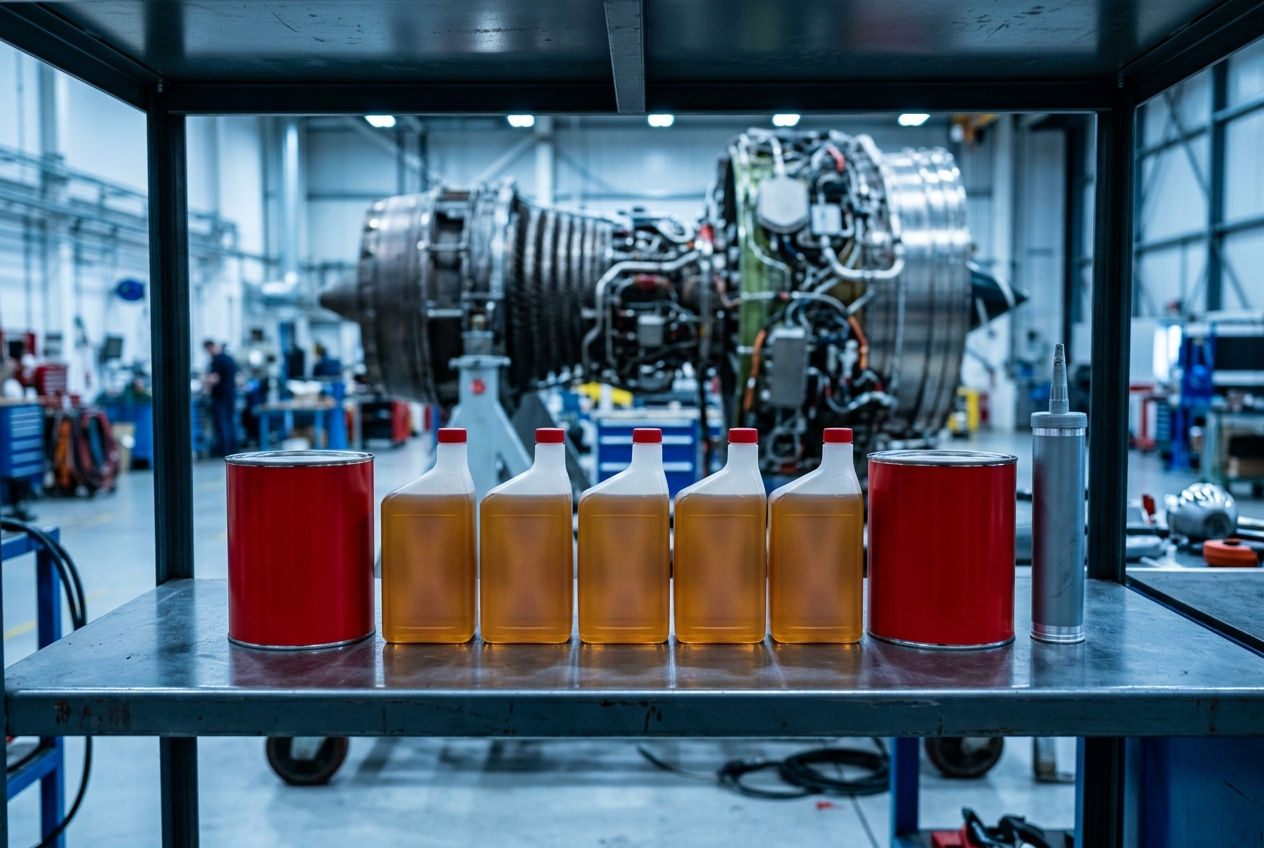
Lubricants are ordered against specifications, not brand names. Get the specification right and any approved product will do the job; get it wrong and no amount of brand loyalty will help. Here is how the main families fit together.
Turbine engine oils
Turbine oils are synthetic ester-based fluids that lubricate and cool bearings and gearboxes at high temperature. They are grouped by viscosity class and by the specification they meet, and engine manufacturers publish approved product lists for each engine type. Mixing brands is generally discouraged unless both products are approved for the engine and the manufacturer permits it — always check the engine manual before topping up with a different product.
Piston engine oils
Piston aircraft use mineral or ashless dispersant oils in SAE grades, plus multigrade options for wide temperature ranges. Break-in and normal operation often call for different products, and the aircraft or engine manufacturer's service instructions decide which. Piston oils are a consumable item, so pack size and delivered cost per quart matter as much as the grade.
Hydraulic fluids
Aircraft hydraulic systems use either phosphate ester or mineral-based fluids depending on the type. They are not interchangeable, and cross-contamination damages seals and components. Fluids are supplied against published specifications, and clean handling matters: use the correct dispensing equipment and never decant into an unlabelled container.
Greases
Aviation greases cover wheel bearings, airframe points, control surfaces, screw jacks and high-temperature applications. They are selected by base oil, thickener type and temperature range, and most are supplied against a MIL-PRF or equivalent specification. Cartridges suit grease guns; tubs and tins suit hand packing.
Preservative and specialty fluids
Storage and preservation oils protect engines and components during shipping or lay-up. Specialty and military specification fluids cover de-icing, instrument, damping and other niche duties — all of them ordered by specification, because trade names change more often than specifications do.
What to check before you order
- The specification called out by your maintenance data, not just the product name
- Pack size, because lubricants are only sold in the manufacturer's pack range
- Batch and manufacturing date, and the remaining shelf life on receipt
- Whether a Certificate of Analysis, MSDS or Technical Data Sheet is required
- Transport classification: some products cannot fly, which changes the lead time
Storage and shelf life
Store lubricants sealed, off the floor, out of direct sunlight and within the temperature range on the label. Record the batch on receipt so a product can be traced back if a query arises later. Where shelf life applies, we quote the remaining life before despatch so your stores can accept the material against your own minimum-life policy.
Frequently asked questions
- Can I mix two approved turbine oils?
- Only if the engine manufacturer's documentation permits it. Check the engine manual before mixing brands, even when both products are approved.
- Do you quote remaining shelf life on lubricants?
- Yes. Batch, manufacturing date and remaining shelf life are confirmed before despatch for shelf-life controlled products.
Need a price for a part number?
Send the part number, quantity and required condition — routine enquiries are answered within one business day, AOG immediately.
Request a quotation