Aircraft Parts Documentation and Certification Guide
Which certificate applies to which material, what each one actually proves, and why the requirement has to be agreed before the purchase order is placed.
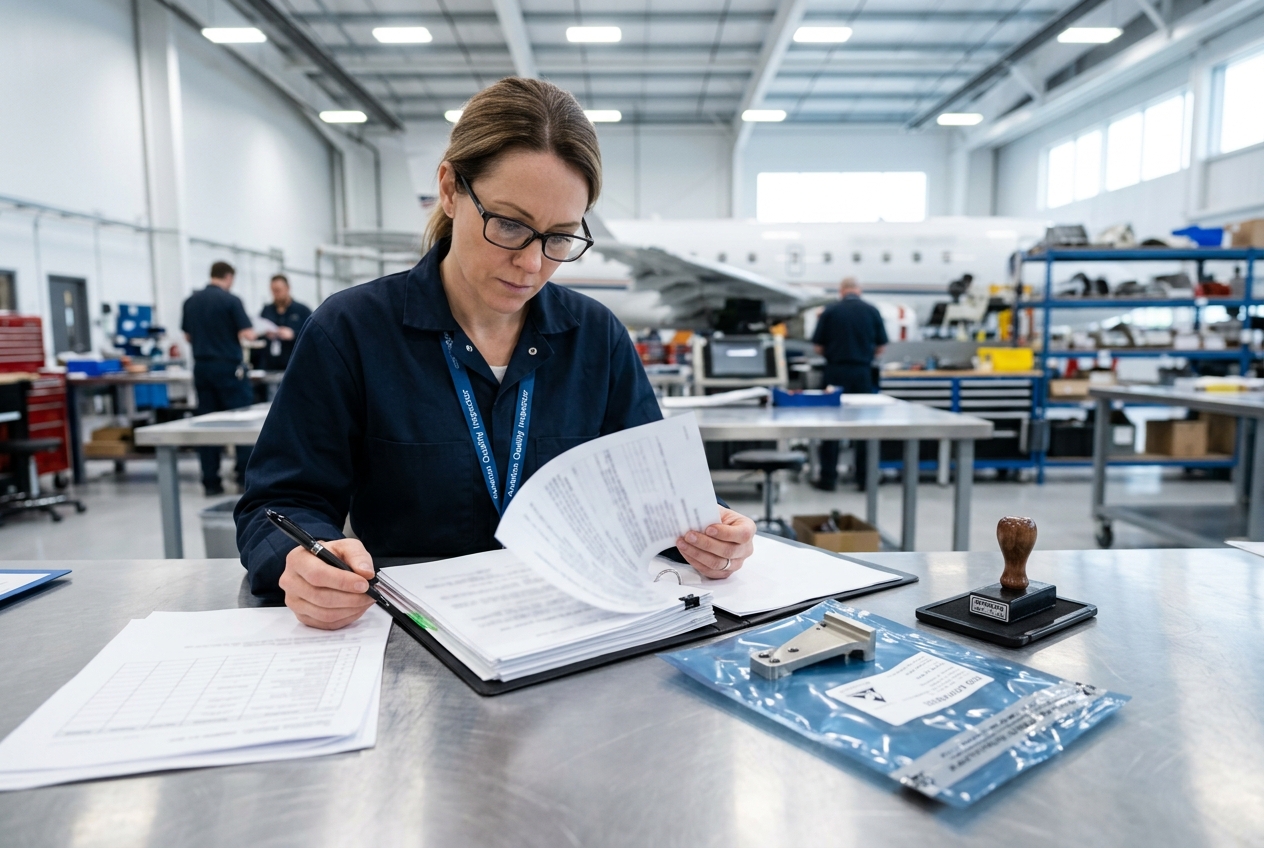
Paperwork is part of the product. Two identical parts with different documentation are, commercially and legally, two different items — and the difference is usually discovered at goods receipt, which is the worst possible moment.
The common documents
- Certificate of Conformity — the supplier or manufacturer confirms the item conforms to the stated specification
- Manufacturer's certificate — issued by the manufacturer for the batch or item
- Test certificate — records the results of specified tests on the material
- Certificate of Analysis — batch chemical or physical properties, common for lubricants and chemicals
- FAA 8130-3 — an authorised release certificate issued under FAA rules where applicable
- EASA Form 1 — the equivalent authorised release certificate under EASA rules
- Certificate of Origin — states the country of origin, often needed for customs
- MSDS/SDS and Technical Data Sheet — safety and technical information for chemicals
- Traceability documentation — the chain back to the source of the material
Which document applies
The applicable document depends on the product, its manufacturer, its source and its condition. New standard hardware typically travels with a Certificate of Conformity and manufacturer documentation. Overhauled or repaired rotables normally require an authorised release certificate from the organisation that returned them to service. Lubricants and chemicals rely on a Certificate of Analysis, an MSDS and a Technical Data Sheet rather than a release certificate.
Agree it before the order
Documentation requirements must be confirmed at quotation and purchase order stage. State them in the enquiry, check that the quotation repeats them, and repeat them again on the purchase order. If a document cannot be provided for a particular item, the honest answer is to say so before the order is placed — and to let you decide whether to buy on that basis.
What documentation does not do
A certificate confirms what it says and nothing more. A Certificate of Conformity is not a release to service. A Certificate of Analysis describes a batch, not an installation approval. Whether a part may be installed on your aircraft is a decision for your organisation against your approved data and approvals.
Storing and matching documents
Keep the certificate with the material, and check three things on receipt: the part number, the batch or serial number, and the condition. If any of the three disagrees with the invoice or packing list, quarantine the material and raise a query straight away rather than filing the difference.
Our position
Where applicable and available, material may be supplied with the documents above depending on product, manufacturer, source and your requirement. We never imply that a certificate exists for material where it does not, and we tell you in writing which documents will accompany each line.
Frequently asked questions
- Is a Certificate of Conformity the same as an EASA Form 1?
- No. A Certificate of Conformity confirms conformity to a specification; an EASA Form 1 (or FAA 8130-3) is an authorised release certificate issued under the relevant regulatory system.
- When should I state my documentation requirement?
- In the enquiry, and again on the purchase order. Requirements are confirmed at quotation and purchase order stage, never after despatch.
Need a price for a part number?
Send the part number, quantity and required condition — routine enquiries are answered within one business day, AOG immediately.
Request a quotation